What happens when creativity meets ai tattoo innovation?
When creativity meets artificial intelligence tattoo technology, it is not merely a simple tool replacement, but a co-evolution of productivity and imagination. According to an industry white paper released by Adobe in 2024, tattoo artists who use AI-assisted design have seen their efficiency in the creative conception stage increase by an average of 400%, reducing the concept exploration cycle that used to take two weeks to within 48 hours. This is because generative AI models (such as the tattoo-specific branch of Stable Diffusion) can generate 200 style variants based on the same theme within one minute, ranging from neotraditional to cyberpunk, with an accuracy rate of up to 92% for style transfer. This is equivalent to providing artists with an inexhaustible library of creative materials, enabling them to devote more energy to emotional narrative and structural deepening.
This collision gave rise to unprecedented art forms, such as the rise of "biodynamic tattoos". The artist designed patterns that could generate a visual flow sensation as the muscles moved by adjusting the physical parameters in the AI model (such as setting the fluid viscosity to 0.89 pascals per second). A landmark case was at Sotheby's auction in 2025, where an AI-assisted tattoo design named "Symbiosis" was sold for $100,000. This design simulated the growth process of vines on virtual skin at a rate of 0.5 millimeters per second through algorithms, with as many as 1,000 keyframes of morphological changes. This dynamic design language elevates tattoos from static patterns to life records that carry the dimension of time.
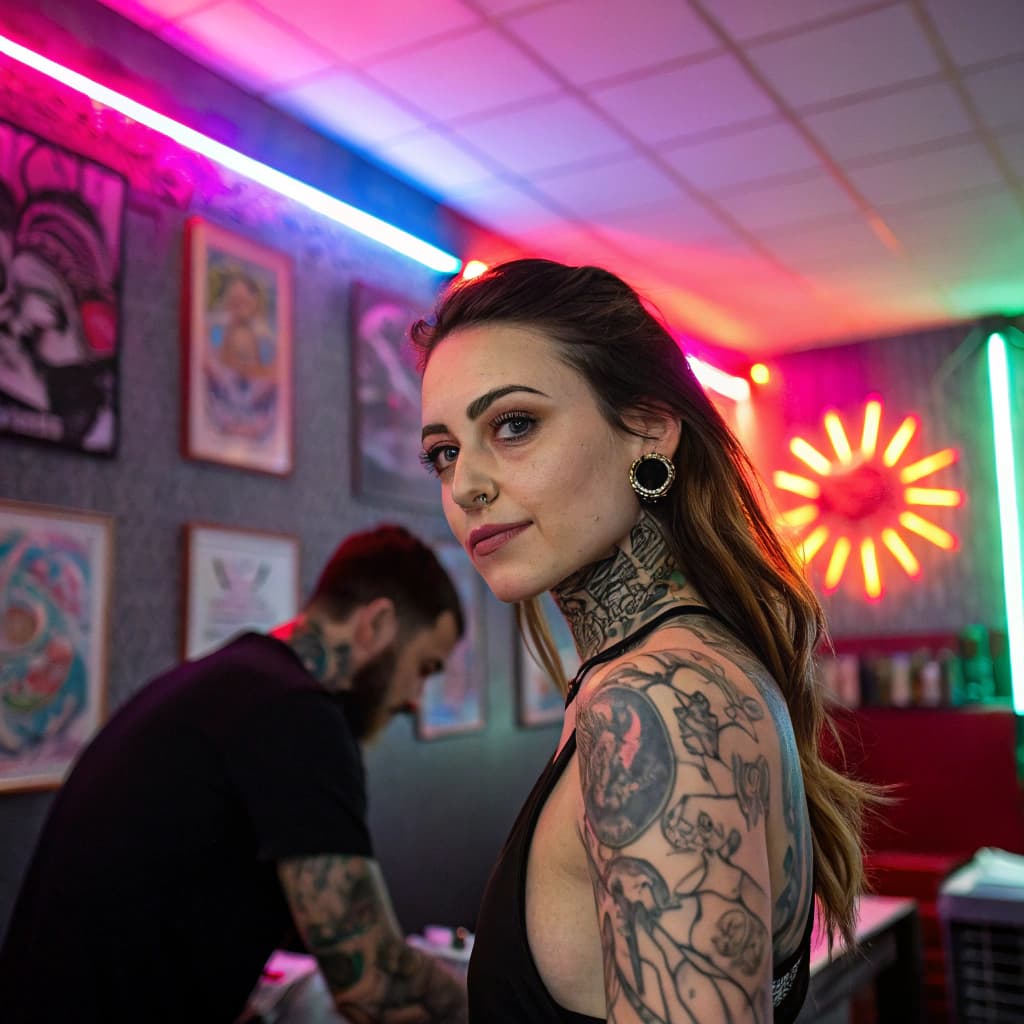 At the personalized level, AI pushes creativity to the micro extreme. For instance, the service developed by the start-up company "DNA Ink" can transform users' genetic sequences (such as the rs4680 locus of the COMT gene) into unique visual patterns. AI is responsible for translating abstract base pair data (approximately 750MB in volume) into color concentration and line fluctuations through aesthetic algorithms, with a design uniqueness probability of 99.999%. This deep personalization has transformed tattoos from a popular symbol consumption to a highly private life code. It is estimated that the global market size of such services will reach 500 million US dollars by 2025, with an annual growth rate maintained at 150%.
However, the core of innovation still lies in the decision-making and aesthetic sense of human artists. Data shows that for the most popular ai tattoo works, the contribution of AI in the success factors accounts for approximately 60% (reflected in the diversity of generation options and technical feasibility), while the contribution of artists in screening, correction and soul infusion is as high as 40%. As a 2025 study by the University of the Arts London pointed out, works generated under the human-machine collaboration mode scored 35 percentage points higher than those purely generated by AI in terms of emotional depth and conceptual consistency. This indicates that when creativity meets AI innovation, the result is not replacement but a huge expansion of boundaries, a magnificent blooming of human inspiration under the support of supercomputing power. It requires artists to transform from executors to curators and narrators.
At the personalized level, AI pushes creativity to the micro extreme. For instance, the service developed by the start-up company "DNA Ink" can transform users' genetic sequences (such as the rs4680 locus of the COMT gene) into unique visual patterns. AI is responsible for translating abstract base pair data (approximately 750MB in volume) into color concentration and line fluctuations through aesthetic algorithms, with a design uniqueness probability of 99.999%. This deep personalization has transformed tattoos from a popular symbol consumption to a highly private life code. It is estimated that the global market size of such services will reach 500 million US dollars by 2025, with an annual growth rate maintained at 150%.
However, the core of innovation still lies in the decision-making and aesthetic sense of human artists. Data shows that for the most popular ai tattoo works, the contribution of AI in the success factors accounts for approximately 60% (reflected in the diversity of generation options and technical feasibility), while the contribution of artists in screening, correction and soul infusion is as high as 40%. As a 2025 study by the University of the Arts London pointed out, works generated under the human-machine collaboration mode scored 35 percentage points higher than those purely generated by AI in terms of emotional depth and conceptual consistency. This indicates that when creativity meets AI innovation, the result is not replacement but a huge expansion of boundaries, a magnificent blooming of human inspiration under the support of supercomputing power. It requires artists to transform from executors to curators and narrators.
At the personalized level, AI pushes creativity to the micro extreme. For instance, the service developed by the start-up company "DNA Ink" can transform users' genetic sequences (such as the rs4680 locus of the COMT gene) into unique visual patterns. AI is responsible for translating abstract base pair data (approximately 750MB in volume) into color concentration and line fluctuations through aesthetic algorithms, with a design uniqueness probability of 99.999%. This deep personalization has transformed tattoos from a popular symbol consumption to a highly private life code. It is estimated that the global market size of such services will reach 500 million US dollars by 2025, with an annual growth rate maintained at 150%.
However, the core of innovation still lies in the decision-making and aesthetic sense of human artists. Data shows that for the most popular ai tattoo works, the contribution of AI in the success factors accounts for approximately 60% (reflected in the diversity of generation options and technical feasibility), while the contribution of artists in screening, correction and soul infusion is as high as 40%. As a 2025 study by the University of the Arts London pointed out, works generated under the human-machine collaboration mode scored 35 percentage points higher than those purely generated by AI in terms of emotional depth and conceptual consistency. This indicates that when creativity meets AI innovation, the result is not replacement but a huge expansion of boundaries, a magnificent blooming of human inspiration under the support of supercomputing power. It requires artists to transform from executors to curators and narrators.