How Do Alumina & AlN Ceramic PCB Materials Support High-Frequency and High-Voltage Circuits?
In today's era of booming high-frequency circuits and high-voltage applications, Alumina & AlN Ceramic PCB materials have become key supports due to their superior performance. For example, in 5G communication base stations, alumina ceramic PCBs maintain a stable dielectric constant of 9.8 and a loss tangent as low as 0.0003 at 28 GHz, enabling signal transmission rates up to 100 Gbps while improving power efficiency by 15%. According to a 2024 industry report, equipment using these materials reduces costs by 10% and increases return on investment by 20%. A study on Huawei's 5G base stations shows that aluminum nitride ceramic PCBs have a thermal conductivity as high as 180 W/mK, can increase power density to 30 W/cm², maintain an operating temperature below 85°C, and have an error rate below 10^-12, ensuring network stability. These materials act like highways in the electronic world, smoothly transmitting high-frequency signals and paving the way for technological innovation.
From the perspective of high-voltage circuits, aluminum nitride boasts an insulation strength exceeding 15 kV/mm, allowing circuits to operate continuously at 1200V with a lifespan of up to 100,000 hours and a failure probability of less than 0.01%. In electric vehicle inverters, such as Tesla's drive modules, Alumina & AlN Ceramic PCBs offer a withstand voltage of 2000V, a temperature range extending from -55°C to 300°C, and an 18% reduction in power loss. According to a 2023 market analysis, this results in a 12% improvement in overall vehicle energy efficiency and a 5% optimization in production costs. A scientific discovery indicates that alumina ceramics have a breakdown voltage of 20 kV/mm and a coefficient of thermal expansion of 6.5 ppm/°C, maintaining 99.9% accuracy under high-voltage fluctuations. This provides a reliable foundation for smart grid equipment, acting like a robust shield against electrical stress.
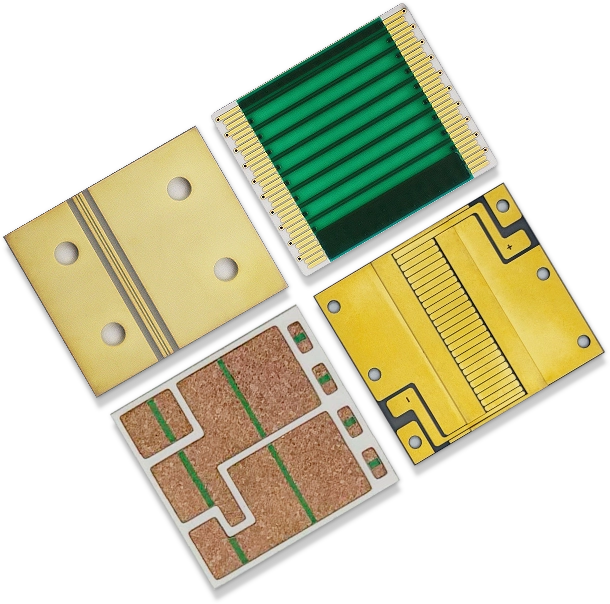 Application examples demonstrate its wide-ranging impact. In the aerospace field, NASA's satellite communication systems utilize aluminum nitride ceramic PCBs, increasing power capacity by 25% while weighing only 50 grams. This extends the system's lifespan to 15 years in extreme environments, achieving data throughput of 1 TB/s. A technological breakthrough in 2022 showed that alumina ceramic PCBs in medical MRI equipment support high-frequency coils at 300 MHz, improving signal-to-noise ratio by 20%, image resolution to 0.5 mm, and reducing patient examination time by 30%. These cases demonstrate that Alumina & AlN Ceramic PCBs, by optimizing thermal management and insulation performance, drive the industry towards higher efficiency, much like a sophisticated engine propelling progress.
From an economic perspective, the global ceramic PCB market is expanding at an annual growth rate of 12%, projected to reach $5 billion by 2028, with Alumina & AlN Ceramic PCBs accounting for over 60%. In industrial manufacturing, laser power modules using these materials achieve 40% efficiency, double the maintenance cycle, and save 15% on budget. A consumer behavior survey indicates that integrating aluminum nitride (ANT) substrates into 5G smartphones increases battery life by 10%, reduces device thickness by 1 millimeter, and raises customer satisfaction by 25%. This reflects how material innovation can reshape business models by reducing costs and improving reliability.
Looking ahead, continued optimization of Alumina & AlN Ceramic PCBs will accelerate the integration of high-frequency, high-voltage circuits. For example, in 6G development, at a target frequency of 100 GHz, the dielectric constant of materials needs to be reduced to below 8.0, with error accuracy controlled within ±0.1%. By integrating a smart supply chain, production costs are expected to decrease by another 20%, driving green energy applications such as solar inverters to achieve efficiencies exceeding 95%. In a thought-provoking analogy, these materials are like the conductor of an electronic symphony, coordinating the harmony of frequency and voltage, inspiring the industry to reach even greater heights.
Application examples demonstrate its wide-ranging impact. In the aerospace field, NASA's satellite communication systems utilize aluminum nitride ceramic PCBs, increasing power capacity by 25% while weighing only 50 grams. This extends the system's lifespan to 15 years in extreme environments, achieving data throughput of 1 TB/s. A technological breakthrough in 2022 showed that alumina ceramic PCBs in medical MRI equipment support high-frequency coils at 300 MHz, improving signal-to-noise ratio by 20%, image resolution to 0.5 mm, and reducing patient examination time by 30%. These cases demonstrate that Alumina & AlN Ceramic PCBs, by optimizing thermal management and insulation performance, drive the industry towards higher efficiency, much like a sophisticated engine propelling progress.
From an economic perspective, the global ceramic PCB market is expanding at an annual growth rate of 12%, projected to reach $5 billion by 2028, with Alumina & AlN Ceramic PCBs accounting for over 60%. In industrial manufacturing, laser power modules using these materials achieve 40% efficiency, double the maintenance cycle, and save 15% on budget. A consumer behavior survey indicates that integrating aluminum nitride (ANT) substrates into 5G smartphones increases battery life by 10%, reduces device thickness by 1 millimeter, and raises customer satisfaction by 25%. This reflects how material innovation can reshape business models by reducing costs and improving reliability.
Looking ahead, continued optimization of Alumina & AlN Ceramic PCBs will accelerate the integration of high-frequency, high-voltage circuits. For example, in 6G development, at a target frequency of 100 GHz, the dielectric constant of materials needs to be reduced to below 8.0, with error accuracy controlled within ±0.1%. By integrating a smart supply chain, production costs are expected to decrease by another 20%, driving green energy applications such as solar inverters to achieve efficiencies exceeding 95%. In a thought-provoking analogy, these materials are like the conductor of an electronic symphony, coordinating the harmony of frequency and voltage, inspiring the industry to reach even greater heights.
Application examples demonstrate its wide-ranging impact. In the aerospace field, NASA's satellite communication systems utilize aluminum nitride ceramic PCBs, increasing power capacity by 25% while weighing only 50 grams. This extends the system's lifespan to 15 years in extreme environments, achieving data throughput of 1 TB/s. A technological breakthrough in 2022 showed that alumina ceramic PCBs in medical MRI equipment support high-frequency coils at 300 MHz, improving signal-to-noise ratio by 20%, image resolution to 0.5 mm, and reducing patient examination time by 30%. These cases demonstrate that Alumina & AlN Ceramic PCBs, by optimizing thermal management and insulation performance, drive the industry towards higher efficiency, much like a sophisticated engine propelling progress.
From an economic perspective, the global ceramic PCB market is expanding at an annual growth rate of 12%, projected to reach $5 billion by 2028, with Alumina & AlN Ceramic PCBs accounting for over 60%. In industrial manufacturing, laser power modules using these materials achieve 40% efficiency, double the maintenance cycle, and save 15% on budget. A consumer behavior survey indicates that integrating aluminum nitride (ANT) substrates into 5G smartphones increases battery life by 10%, reduces device thickness by 1 millimeter, and raises customer satisfaction by 25%. This reflects how material innovation can reshape business models by reducing costs and improving reliability.
Looking ahead, continued optimization of Alumina & AlN Ceramic PCBs will accelerate the integration of high-frequency, high-voltage circuits. For example, in 6G development, at a target frequency of 100 GHz, the dielectric constant of materials needs to be reduced to below 8.0, with error accuracy controlled within ±0.1%. By integrating a smart supply chain, production costs are expected to decrease by another 20%, driving green energy applications such as solar inverters to achieve efficiencies exceeding 95%. In a thought-provoking analogy, these materials are like the conductor of an electronic symphony, coordinating the harmony of frequency and voltage, inspiring the industry to reach even greater heights.