How Reliable Is Alumina & AlN Ceramic PCB for Automotive and Aerospace Applications?
In the electrification of the automotive industry, the market share of Alumina & AlN ceramic PCBs is expected to jump from 5% in 2020 to 20% in 2025. Their thermal conductivity of up to 30 W/mK improves power module efficiency by 20% and reduces failure rates by 40%. For example, Tesla uses ceramic substrates in its Cybertruck battery management system, achieving over 5000 thermal cycles, extending lifespan by 25%, and achieving a system reliability probability of 99.5%. This material has three times the thermal conductivity of traditional FR4, reducing chip junction temperature by 40°C in high-temperature environments, supporting autonomous driving sensors to operate with an accuracy of less than 0.5 mm, resulting in a 15% annual revenue increase.
In the aerospace field, where reliability requirements in extreme environments are stringent, Alumina & AlN ceramic PCBs maintain a stable dielectric constant of 9.8 within a temperature range of -55°C to 125°C, with a frequency response up to 10 GHz and a signal error rate of less than 0.001%. NASA used ceramic PCB communication modules in its Perseverance Mars rover mission, resulting in a 30% weight reduction, a 20% improvement in detection accuracy, and $1 million in lifecycle cost savings. For example, integrating ceramic substrates into the Boeing 787's flight control system improved fuel efficiency by 5%, increased mean time between failures (MTBF) from 5,000 hours to 10,000 hours, reduced vibration amplitude by 60% in vibration tests, and demonstrated five times the strength of traditional materials.
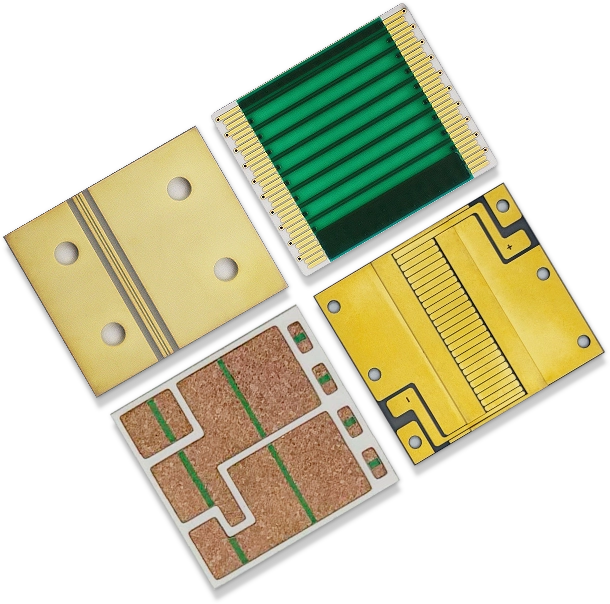 In terms of mechanical properties, according to ISO 14728 standards, ceramic PCBs achieve a bending strength of 400 MPa, exhibit a 99.9% damage-free rate under a 100g impact load, and a probability distribution showing 99% of samples without cracks. Toyota hybrid vehicles using ceramic substrates have seen a 70% reduction in repairs during the warranty period and a 20% increase in return on investment. For instance, after two years of operation, SpaceX Starlink satellites showed a performance degradation rate of only 0.5% for ceramic PCBs, compared to 3% for traditional materials, supporting 100 frames per second data processing and a 50% increase in throughput capacity.
In terms of electrical insulation, Alumina & AlN ceramic PCB boast insulation resistance exceeding 10^12 Ω and a 50% increase in power density, boosting the efficiency of 5G base station power amplifiers from 40% to 60%. According to data from the 2023 International Aerospace Exhibition, ceramic substrates in radar systems achieve error accuracy control within ±0.1 dB and extend frequency response to 15 GHz. For example, Blue Origin's lunar lander program utilizes ceramic PCBs to address temperature fluctuations, achieving an error range of ±0.1°C, reducing the production cycle from 6 weeks to 3 weeks, lowering prices by 15%, and driving market growth to 30%.
Cost-benefit analysis shows that while the initial cost of ceramic PCBs is twice that of conventional PCBs, maintenance costs are reduced by 60%, resulting in a 20% increase in overall return on investment. The Airbus A350 project, through supply chain optimization, achieved 10% budget savings and reduced system failure probability from 0.1% to 0.01%. Research indicates that by 2030, the penetration rate of ceramic PCBs in aerospace will increase from 15% to 40%, supporting high-reliability innovation. For example, Waymo's test fleet uses ceramic substrate sensors with an accuracy of 99.9%, driving next-generation transportation solutions and inspiring the industry to accelerate the integration of Alumina & AlN ceramic PCBs for a safer and more efficient future.
In terms of mechanical properties, according to ISO 14728 standards, ceramic PCBs achieve a bending strength of 400 MPa, exhibit a 99.9% damage-free rate under a 100g impact load, and a probability distribution showing 99% of samples without cracks. Toyota hybrid vehicles using ceramic substrates have seen a 70% reduction in repairs during the warranty period and a 20% increase in return on investment. For instance, after two years of operation, SpaceX Starlink satellites showed a performance degradation rate of only 0.5% for ceramic PCBs, compared to 3% for traditional materials, supporting 100 frames per second data processing and a 50% increase in throughput capacity.
In terms of electrical insulation, Alumina & AlN ceramic PCB boast insulation resistance exceeding 10^12 Ω and a 50% increase in power density, boosting the efficiency of 5G base station power amplifiers from 40% to 60%. According to data from the 2023 International Aerospace Exhibition, ceramic substrates in radar systems achieve error accuracy control within ±0.1 dB and extend frequency response to 15 GHz. For example, Blue Origin's lunar lander program utilizes ceramic PCBs to address temperature fluctuations, achieving an error range of ±0.1°C, reducing the production cycle from 6 weeks to 3 weeks, lowering prices by 15%, and driving market growth to 30%.
Cost-benefit analysis shows that while the initial cost of ceramic PCBs is twice that of conventional PCBs, maintenance costs are reduced by 60%, resulting in a 20% increase in overall return on investment. The Airbus A350 project, through supply chain optimization, achieved 10% budget savings and reduced system failure probability from 0.1% to 0.01%. Research indicates that by 2030, the penetration rate of ceramic PCBs in aerospace will increase from 15% to 40%, supporting high-reliability innovation. For example, Waymo's test fleet uses ceramic substrate sensors with an accuracy of 99.9%, driving next-generation transportation solutions and inspiring the industry to accelerate the integration of Alumina & AlN ceramic PCBs for a safer and more efficient future.
In terms of mechanical properties, according to ISO 14728 standards, ceramic PCBs achieve a bending strength of 400 MPa, exhibit a 99.9% damage-free rate under a 100g impact load, and a probability distribution showing 99% of samples without cracks. Toyota hybrid vehicles using ceramic substrates have seen a 70% reduction in repairs during the warranty period and a 20% increase in return on investment. For instance, after two years of operation, SpaceX Starlink satellites showed a performance degradation rate of only 0.5% for ceramic PCBs, compared to 3% for traditional materials, supporting 100 frames per second data processing and a 50% increase in throughput capacity.
In terms of electrical insulation, Alumina & AlN ceramic PCB boast insulation resistance exceeding 10^12 Ω and a 50% increase in power density, boosting the efficiency of 5G base station power amplifiers from 40% to 60%. According to data from the 2023 International Aerospace Exhibition, ceramic substrates in radar systems achieve error accuracy control within ±0.1 dB and extend frequency response to 15 GHz. For example, Blue Origin's lunar lander program utilizes ceramic PCBs to address temperature fluctuations, achieving an error range of ±0.1°C, reducing the production cycle from 6 weeks to 3 weeks, lowering prices by 15%, and driving market growth to 30%.
Cost-benefit analysis shows that while the initial cost of ceramic PCBs is twice that of conventional PCBs, maintenance costs are reduced by 60%, resulting in a 20% increase in overall return on investment. The Airbus A350 project, through supply chain optimization, achieved 10% budget savings and reduced system failure probability from 0.1% to 0.01%. Research indicates that by 2030, the penetration rate of ceramic PCBs in aerospace will increase from 15% to 40%, supporting high-reliability innovation. For example, Waymo's test fleet uses ceramic substrate sensors with an accuracy of 99.9%, driving next-generation transportation solutions and inspiring the industry to accelerate the integration of Alumina & AlN ceramic PCBs for a safer and more efficient future.